Senin, 18 Maret 2013

Ford still testing the Ecosport, official launch date not announced yet


Sports Utility Vehicles might have become a rage in India, a few thousands of potential customers might be waiting for its launch ever since it was unveiled more than a year ago at the 2012 Auto Expo in New Delhi and the media might be carrying all sorts of speculations on the expected date of launch of this hugely-anticipated model. But, it looks like Ford is silently continuing with its work without giving a damn about these things. Neither has Ford confirmed the date of launch of the Ecosport nor is it done with the testing formalities. Three top-end diesel variants of the Ecosport caught testing yesterday in the busy Chennai-Trichy Highway (NH 45), some 50 km from Ford India's manufacturing facility, proves that.


Spy shots of the Ford Ecosport have become the most common thing on automotive websites these days. We at Anything On Wheels have shot the Ecosport testing in and around Chennai on two separate occasions before. While the first spotting was of a fully camouflaged model, the second set of spy shots gave us a clear glimpse of the base petrol variant. This time though, all three Ecosports caught testing were top-end diesel variants, as proved by the 'TDCi' and 'Titanium' badges on the rear door. As such, features like body-colored door handles and rear view mirrors, chrome-lined front grille, fog lamps with chrome surround and roof rails that were not available in the base variant earlier, have found their way into this variant.


Ever since its unveiling, the Ford Ecosport has been attracting people just by virtue of its looks. That is clearly evident on the road, more so in that bright shade of orange, that adds a lot of character to the Ecosport. The multi-layered, chrome-lined grille up front and the pillarless rear windscreen steal the show, as does the rear door-mounted spare wheel. The compact dimensions of the Ecosport will be a boon inside the city while the high stance will prove its worth on potholed country roads. Three engine options, a 1.5-liter TiVCT petrol engine, a 1.5-liter TDCi diesel engine and a 1.0-liter 'EcoBoost' petrol engine are expected to power the Ecosport. Being a Ford, we can safely expect the Ecosport to sport a superb ride and handling characteristics too.


All in all, the Ecosport looks to be perfectly armored to succeed in the Indian market. For that to happen though, the model should first go on sale in India. Of late, Ford has started a lot of marketing initiatives to keep the Ecosport in limelight ahead of its official launch. Apart from displaying the Ecosport at select malls in Delhi and Mumbai and releasing a schedule for public displays in other Indian cities, Ford is running an "Urban Discoveries" campaign to promote the Ecosport amongst the general public. The launch is expected only after the conclusion of these events, which means the Ecosport is not set for launch until end of May. So folks, let the wait continue!


Senin, 11 Maret 2013

2013 Geneva - Qoros makes its global debut with 3 Sedan


Holding their own against the heavyweight launches of the 2013 Geneva Motor Show were three cars that would have easily passed off as those belonging to an European automotive brand. Closer inspection revealed a hitherto unknown logo and the fact that the cars actually belonged to a new brand called 'Qoros'. The biggest surprise though is still to come. Qoros is an equal partnership venture between Chery Automobile, one of China's biggest automobile manufacturers and Israel Corporation, the country's largest holding company. Yes, we are referring to the same Chery that became popular for all the wrong reasons with its QQ, a model that was remarkably similar to the earlier Daewoo Matiz.

The models on display were the 3 Sedan, 3 Estate Concept and 3 Cross Hybrid Concept. As the names suggest, all three models belong to the same '3' platform with a couple of more models planned to bring in volumes. Though all three models look production-ready, the 3 Sedan is the one that's slated for commercial launch later this year in China and Europe.


For many reasons, Chinese cars don't bring along good sketches on our minds. Qoros might end up changing that, as the 3 Sedan and it's concept siblings are blessed with a thoroughly modern European design that wouldn't look out of place in a Volkswagen or Fiat. We might be exaggerating here, but the point is, the Qoros models are that good, relatively speaking.

The mesh grille filled in with black 'clouds', the thick chrome strip at the top of the grille, the chunky C-Pillar and the horizontal streaks of Light Emitting Diodes makes the Qoros 3 Sedan look like nothing else from China. In what can be termed as an emerging style statement, both the front and rear lights have the word 'Qoros' inscribed on them. The interiors are no less impressive, looking at the official shots revealed by the company. Though the layout isn't new, the execution, fit and finish seem to be good, with the Qoros 3 Sedan sporting a flat-bottom steering wheel, a high-resolution touch screen infotainment system and generous space along with other regular set of features including xenon headlamps and cruise control.


Developed in collaboration with AVL of Austria, two 1.6-liter engines are expected to power the 3 Sedan. While the naturally aspirated version churns out 126 bhp, the turbocharged version is good for 156 bhp. Mated to this is a standard 6-speed manual transmission and an optional 7-speed dual-clutch automatic transmission. With the safety, ride and handling characteristics tuned to European standards, the Qoros 3 Sedan doesn't look like a compromise any which way you look at it. To be produced in an all-new facility in Changshu in China, we feel that the 3 Sedan has what it takes to have a genuine shot at success, even in markets outside of China.

Though the brand has used the 2013 Geneva Motor Show as a launchpad for its 3 platform, the company is planning to develop new platforms as it intends to keep growing. Such clarity and long-term planning has to be attributed to the management team at Qoros, which has executives from many different countries and continents, who seem to have successfully imparted a global mindset within the company.


With a plan to launch add models to its lineup every 6 to 8 months, Qoros gave a clear hint of the next two models to join the 3 Sedan. While the 3 Estate Concept is an extended estate variant of the 3 with increased passenger space and functionality, the 3 Cross Hybrid Concept is an attractive compact crossover. Featuring an advanced hybrid drive with a 50kW electric motor in addition to a 1.2-liter, 3-cylinder, turbocharged petrol engine with 130 bhp and an automatic software to control transition between petrol engine four wheel drive, electric motor rear wheel drive and all wheel drive, Qoros is using the 3 Cross Hybrid Concept as a technological showpiece.

Coming after the demise of quite a few brands like Pontiac, Mercury, Hummer, Saturn and Saab over the last few years, the birth of Qoros is a reason to cheer. Let's join the party with the hope that the 3 Cross Hybrid will eventually reach our shores.


Sabtu, 09 Maret 2013

Ashok Leyland Jan Bus spotted testing in Chennai


As the buses plying on Indian roads keep improving towards international standards with the arrival of global brands like Volvo and Mercedes-Benz, the Indian commercial-vehicle manufacturers who have traditionally dominated the market are being pulled out of their comfort zones and forced to come up with something indigenous to stay afloat. Ashok Leyland, head-quartered in Chennai and the most traditional and conservative brand of all, is undergoing such a transformation now. The proof of that is what you see in this post.

Ashok Leyland made it to the headlines last year when it unveiled the Jan Bus, which the company claims is the world's first single-step entry, front engine and fully flat floor bus, at the 2012 Auto Expo in New Delhi. In the Jan Bus, Ashok Leyland seems to have found out a niche that none of the global brands have filled in for various reasons. In regular front-engined buses, there is an axle that runs below the passenger compartment transferring the power to the rear wheels. That's why most low floor buses gets rid of this axle by having their engines placed at the rear which invariably increases the cost. Ashok Leyland's Jan Bus bucks the trend, as it qualifies as a low floor bus inspite of having its engine at the front.

Unlike many models that disappear without a trace after the paparazzi of the Auto Show, the Jan Bus project is very much alive and kicking. If ever proof was needed, here it is.


Two Jan Bus prototypes were spotted testing in the busy GST Road in Chennai yesterday hinting that the project is running at a brisk pace. One was an air-conditioned model while the other was a regular model without air-conditioning. From the way in which the buses were driven, it was obvious that the Jan Bus was powerful, quick and agile. They were refined, accelerated quickly, changed lanes at will and, importantly, looked stable while doing so. Ashok Leyland has got the styling right as well, with the Jan Bus featuring a smooth and clean look. The front end, with it's Volvo-inspired headlights look great and the profile features an uncluttered look. The rear could have been slightly better though and the taillights seem to be a tad small for our liking. Large windshields and windows are sure to be well-received by the public, as does the well-appointed seats and driver's cabin that were clearly visible.

The brochure released by Ashok Leyland states that the Jan Bus will be powered by a 6-cylinder 'H Series' engine that's good for 235 HP of power at 2400 rpm and 720 Nm of torque between 1600 to 1800 rpm. This turbocharged, multi-point fuel injected engine runs on CNG and is BS4 compliant. Mated to this is Ashok Leyland's proprietary 'Leymatic' Automated Manual Transmission (AMT) that significantly reduces driver fatigue. If the brochure is to be believed, the interiors of the Jan Bus are sure to impress too, with features like a clutter-free gangway courtesy the cantilever-mounted seats and seat-mounted stanchions, infotainment system for the passengers, full air suspension and a stylish layout with good fit and finish. The seating and door placements are customizable and the Jan Bus can be configured for regular city transportation, Bus Rapid Transit Systems and airport tarmac applications as well.

With the Jan Bus, are we finally looking at a model that's not only going to mount a challenge to global players in India, but also trying to crack open a segment that's hitherto untouched in the global space? We definitely think so and would be surprised if the Jan Bus doesn't succeed.


Jumat, 08 Maret 2013

2013 Geneva - Rolls-Royce Wraith makes its world debut


Rolls-Royce might be revered for being the pinnacle of automotive luxury, but their model range for much of the last decade was pretty much restricted to just the Phantom and the many variants derived out of it. Later, when the Ghost, a smaller and lesser expensive luxury sedan joined the lineup, Rolls-Royce was still left without a model to pit against it's arch-rival Bentley's Continental series. All that is history now, as the Rolls-Royce Wraith finally made its world debut amidst the glitz and grandeur of the 2013 Geneva Motor Show.

The Wraith is thus an important model for Rolls-Royce, not just for being the third new nameplate for the brand since it started rebuilding cars in 2003 under BMW's ownership. It also takes Rolls-Royce one step closer to competing with the full Bentley line-up, a brand with which Rolls-Royce shares a lot of history. The Wraith is a coupe version of the Ghost luxury sedan and based on the same platform.


You probably wouldn't be able to differentiate the Wraith from other Rolls-Royce models at first glance, but look closer and you will notice the deeply-recessed grille which gives the car a bold and powerful look up front. In profile, the Wraith's sweeping fastback design gives the car an unique character, that is further accentuated by the two-tone paint job and the pronounced cut that splits the car into two distinct portions. Coach doors, as Rolls-Royce calls the rear-hinged doors, let us access a cabin that has the finest leather, wood and craftsmanship on offer. Yes, the Wraith might be the fastest, most powerful and the most dynamic Rolls-Royce till date, but it's basic character is still 'luxury'. Highlighting that to the world are the Starlight headliner in which 1340 fiber-optic lamps are woven by hand into the roof lining, giving the impression of a starry night sky and the Canadel Panelling, a contemporary wood finish that sweeps through the interior cosseting the occupants in ultra luxury and comfort.


The V12 engine under the hood of the Wraith churns out 624 bhp of maximum power and 800 Nm of peak torque from as less than 1500 rpm, good enough for sprinting from 0 to 100 km/h in just 4.4 seconds. That's not all. Also making its world debut is a Satellite Aided Transmission that connects with GPS to pre-select the correct gear for the road ahead. Rolls-Royce claims that this 8-speed ZF automatic transmission in tandem with GPS will even detect corners, road junctions and roundabouts in advance and engage the appropriate gears. Extensive usage of voice commands and a touch pad controller with pinch and pull functionality ensures that the Wraith is a true Rolls-Royce in every sense of the word.

With deliveries slated to begin in the second half of this year, the Wraith is all set to add a new chapter in the iconic British brand's rich legacy.


Rabu, 06 Maret 2013

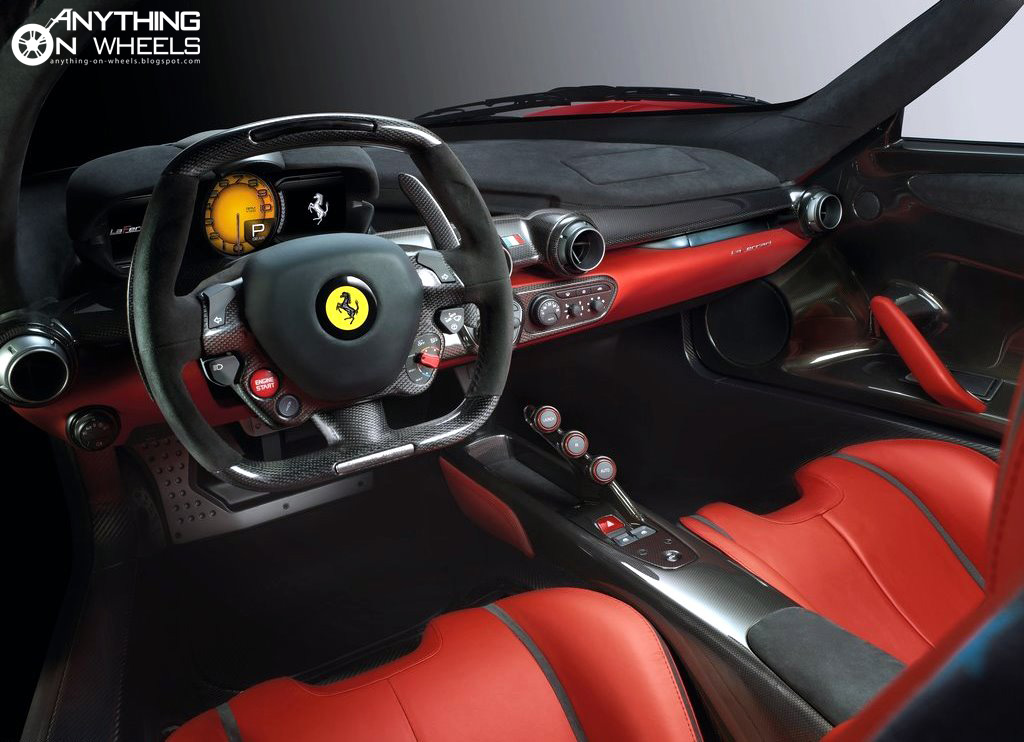
2013 Geneva - LaFerrari, the fastest road car in Ferrari's chequered history, unveiled


Ferrari created a flutter on the floors of the ongoing 2013 Geneva Motor Show when it took the wraps off 'LaFerrari', the Italian brand’s latest, limited-production, V12-engined hybrid sports car. Touted as a successor to the legendary Enzo supercar, the LaFerrari will see a restricted production run of just 499 units, all of which are apparently destined to pre-chosen existing Ferrari owners across the globe.


The name of this all-new Ferrari might not entice you, but it's design most definitely would. Sporting a mix of traditional Ferrari styling cues and modern Formula 1-inspired elements, the LaFerrari is ‘striking’ to say the least. The boomerang headlights with staggered detailing and the circular taillights are a clear nod to the rest of the Ferrari clan while the upward-opening doors are a tribute to the Enzo supercar. The low hood that resembles the nose cone of a F1 race car along with the wings and diffuser in the front and rear bumpers not only bestows the LaFerrari with head-turning looks but also with wind-cheating aerodynamics. That the LaFerrari looks like a proper road-going sports car and not like an alien transporter on wheels makes it all the more appealing.

Look beyond its styling and the LaFerrari has many more interesting things on offer.

Being the company’s first ever hybrid production car, the LaFerrari combines a 6.3-liter V12 Internal Combustion engine with a 120 kW electric motor for a total power output of a colossal 950 bhp. The hybrid system is dubbed 'HY-KERS' and derived out of Ferrari's experience in using the KERS technology in Formula 1. While the electric motor produces high torque at lower revolutions, the I.C.Engine takes care of the torque requirement at higher revs. It comes as no surprise then that the LaFerrari is the fastest road car ever manufactured by the Italian brand with a top speed in excess of 350 km/h. In addition to the performance benefits, the hybrid system ensures lesser emissions as well, making it a double whammy.


The LaFerrari comes across as a technological tour de force. It's unique architecture for improved torsional rigidity and beam stiffness means that seats of each car are 'fixed' as per individual customer's needs. Changes in driving position can still be done though, as both the steering wheel and pedal box are adjustable. The batteries are charged not only during braking but also when additional torque is generated by the V12 engine like, for instance, when cornering. Active aerodynamic devices in the front and rear such as diffusers, guide vane and spoiler deploy automatically based on many parameters that are monitored real time.

Quite rightly then, Ferrari's President Luca di Montezemelo declared "We chose to call this model LaFerrari because it is the maximum expression of what defines our company - excellence." We totally agree.


Selasa, 05 Maret 2013

2013 Geneva - Lamborghini unveils Veneno, celebrates its 50th anniversary in style


Anniversaries don't get better and more exotic than this. In the year of it's 50th anniversary, Automobili Lamborghini S.p.A of Italy has presented itself and, of course all of us, with an all-new, outlandishly-designed and extremely-exclusive super sports car christened the 'Veneno'. Staying true to the tradition of naming its models after bulls, the Veneno, not surprisingly, owes its name to one of the fastest and strongest fighting bulls ever. Apart from this grey-coloured prototype that comes with red, white and green accents depicting the colours of the Italian flag, just 3 Venenos - one each in red, white and green will be produced and sold, each of them costing 3 Million Euros.

That's more than INR 20 Crores by the way. And, it doesn't include taxes. Before you start dreaming, let us also declare that you won't be able to buy one even if you have that kind of cash on hand. Even before it's unveiling at the ongoing 2013 Geneva Motor Show, all 3 Venenos have been spoken for by three lucky souls in the planet.


We are used to seeing evil and wicked cars from Lamborghini in the past, but the Veneno beats them all in a way that's only possible for a Lamborghini. Every single detail in the Veneno is outlandishly evil, with function taking precedence over form. As Lamborghini's press release mentions, the Veneno is all about exceptional dynamics, optimal down-force with minimal drag and perfect cooling of the high-performance engine. What that means to you and me is every vent, crease, fin, wing and recess that you see in Veneno's sheet metal, including the asymmetrical wheel wells, are there for a purpose and not just for the heck of it. Regular Lamborghini design cues such as the scissor doors and Y-shaped lights render some familiarity to the Veneno.

With statistics like 6.5 liters of engine displacement, V12 configuration, 750 hp of peak power, acceleration from 0 to 100 km/h in 2.8 seconds and a top speed of 355 km/h, the Veneno is capable of road-shattering performance. Extensive usage of CFRP (carbon fiber-reinforced plastic) in and out ensures that the Veneno's power-to-weight ratio is surreal, making it a street-legal race car by all means.

Don't forget to get intimidated by clicking on each of these official pictures of the Veneno released by the company. Given the fact that we may never get to lay our hands on one of these cars, that's the next best thing to do.


Kamis, 28 Februari 2013

Hyundai celebrates world's first series production of Zero-Emission Hydrogen Fuel Cell vehicles


The white Hyundai ix35 that you see in this post created history on 26th of February, 2013 when it became the first series-produced fuel cell automobile in the world. Plant 5 in Hyundai's Ulsan manufacturing complex in South Korea was the venue of this landmark achievement that was attended by the company's top management and VIPs. With this, Hyundai is trying to prove the point that fuel cell vehicles are not far off from everyday usage. Though there are quite a few manufacturers working on this technology that's proving to be a great alternative to pure electric vehicles, this move from Hyundai is a giant stride in the world of Zero-Emission vehicles.


Expressing his thoughts at the event, Hyundai Motor Vice Chairman Eok Jo Kim said, “With the ix35 Fuel Cell vehicle, Hyundai is leading the way into the zero-emissions future. The ix35 Fuel Cell is the most eco-friendly vehicle in the auto industry and proves that hydrogen fuel cell technology in daily driving is no longer a dream.”

Between now and 2015, Hyundai plans to build around 1000 units of the ix35 Fuel Cell for lease to public and private fleets. Most of these would primarily be in Europe, as European Union has established a hydrogen road map and initiated construction of hydrogen fueling stations. After 2015, with lowered production costs and a further-developed hydrogen infrastructure, the company will begin manufacturing hydrogen fuel cell vehicles for retail sales as well. With this, Hyundai has achieved its openly-stated claim of being a global leader in the hydrogen fuel cell race.


The ix35 Fuel Cell is a result of over 14 years and many hundred million Euros of research and development by hundreds of engineers at Hyundai's Fuel Cell R&D Center in Mabuk, Korea. Boasting proprietary technology underneath, the ix35 Fuel Cell is powered by hydrogen. A fuel cell stack converts this hydrogen into electricity, which turns the vehicle’s motor. The only emission generated by the ix35 Fuel Cell is "water", making it a true 'Zero-Emission' vehicle that doesn't draw grid power which could have been generated by polluting means.

Not only did the modularization of fuel cell stack, driving device and inverter helped Hyundai downsize the engine to match that of a gasoline engine, the company also claims that the ix35 Fuel Cell has drive-ability and performance similar to that of it's petrol sibling. With a 0 to 100 km/h acceleration time of 12.5 seconds, a top speed of 160 km/h and a single-charge range of 594 km, we don't dispute Hyundai's claim at all.

If only the top honchos here could get a hint from this and start developing infrastructure for a cleaner, greener and meaner India, we could also get a chance to drive cars like this. Until then, all we can do, even if interested, is check out the ix35 Fuel Cell in person at the upcoming 2013 Geneva Motor Show.