 It is a known fact that the current Formula1 grid is one of the most competitive ever to have graced the sport. When the 2011 season started, the lineup had no less than five world champions in Michael Schumacher, Fernando Alonso, Lewis Hamilton, Jenson Button and Sebastian Vettel who, amongst them, held a mind-boggling 12 titles. Then, there were Felipe Massa and Mark Webber both of whom came agonizingly close to becoming a world champion in the previous years and Nico Rosberg who has all the makings of a champion, if given the right car and the right circumstances. As the season progressed, the much-hyped rookies Paul Di Resta and Sergio Perez also proved that they are up there with the very best through their skillful driving.
 To make such a mighty competitive grid look highly uncompetitive needs some really special skills combined with a car that can complement those skills. And, that is exactly what Sebastian Vettel and the Red Bull RB7 had, the latter courtesy master-designer Adrian Newey. And for most of the races this season, they did make the entire field look highly uncompetitive. Now, digest these facts. With 15 of the 19 races over this season, a Red Bull car has started on pole in every single race with Sebastian Vettel being the wingman in 12 of them. Excepting 6 races in which Jenson won 3, Lewis won 2 and Fernando won 1, Vettel has won the remaining 9 of them. With such figures, its hardly surprising that Vettel has officially sealed his second consecutive world title with 4 races remaining.
 But, it was quite an anti-climax for Vettel in the recently-concluded Japanese Grand Prix at Suzuka, as the RB7 that was untouchable in his hands for most part of the season, was beaten fair and square by the McLaren of Jenson Button and the Ferrari of Fernando Alonso. The latter two along with Lewis Hamilton and Mark Webber, are fighting for the second place in the world championship, which is proving to be more interesting and is where the real action is with four top drivers vying for the spot. It was clearly apparent long back that Vettel was running away with the 2011 championship as he, in that RB7, was a class apart and flying above the rest of the field.
 In a sport where your teammate is considered to be your fiercest rival, Mark Webber has had a tough year as Sebastian Vettel has literally crushed him and, in all probability, his confidence too. To be fair to Webber though, it was his Red Bull that always seemed to have all the problems early on in the season. In doing so, Vettel has become the youngest ever multiple world champion in Formula1’s history, a record held by Fernando Alonso until now. For Sebastian Vettel though, this is just another record in an impressively long list that constitutes youngest ever world champion, points scorer, podium finisher, race winner, race leader, pole sitter and what not.But, for the sake of racing fans across the world and for the overall benefit of the sport, I sincerely hope and wish that the 2012 world championship would be a close battle like what we saw in 2010, an epic 5 way fight that went until the last lap of the last race. But, one thing is for sure. If the Vettel-RB7 duo continue to be even half as deadly as they are right now, my wish is going to remain just that as the Vettel train would continue chugging along. Let us, for the moment, assume that we are not witnessing the beginning of an era of Vettel dominance, one that has the potential to become as ruthless and boring as the Michael Schumacher era. Don’t mistake me, that would be great for Vettel and a showcase for his talent but a total disaster for the sport.Images Source: www.redbull.com
I am pleasantly surprised with what’s happening in the Indian automotive industry of late. It seems as if the car-makers have all suddenly figured out the formula to crack open our market and are hell-bent on succeeding in their attempts. If you are still guessing on what the magic formula is, think no more. It is nothing but ‘Value For Money’ (VFM), something that we Indians love. What else would explain the killer prices at which the car makers are launching their all-new models one by one that is proving to be a shock not only for those in the industry circles but also to the general public? By doing so, they not only attract attention and increase the footfalls in their showrooms but also manage to successfully convert them into bookings and are laughing all the way to the bank. Case in point being the most recent launches from Mahindra and Honda, the XUV 500 and the Brio. Being an Indian company, Mahindra knows the hearts and minds of Indian customers like the back of their hand. And, they proved it with their all-new global SUV, the XUV 500. Being the first ever model from Mahindra that was designed and developed to international standards with features and technology found only on cars a segment or two higher, the base variant of the XUV 500 was expected to retail atleast for around 13 lacs, going upto 15 lac rupees for the top-end version. But, when Mr. Anand Mahindra announced the ex-showroom prices that undercut the estimates by atleast a couple of lacs, the media and the public went into a frenzy. Quite deservingly, the XUV 500 has garnered a staggering 5000 bookings within the first few days of its launch in only 5 cities and the company is already quoting a waiting list of 3 months for delivery. Busy times ahead for Mahindra then, until they fulfill these initial orders!
 Even Honda, the Japanese manufacturer hitherto known for charging a premium in all its models and getting away with it due to its superior brand-image, has jumped onto the ‘VFM’ bandwagon. Agreed, they learnt their lessons the hard way and were forced to shave off a significant amount from the ex-showroom prices after the debacle of Jazz, arguably the best premium hatchback in India that failed only due to Honda’s insane pricing. Then came the price cuts for the City, Honda’s perennial best-seller that lost its leadership to newer competitors that offered more value for money. Apparently, those were only the beginning. When Honda announced that the Brio’s prices starts from 3.95 lac onwards, cheaper than its chief challenger the Hyundai i10 1.2, they proved that they mean serious business and are not ready to repeat their mistakes. Expect people to flock to Honda showrooms like there is no tomorrow.All these only spell good times for us, the car-buying public. The cut-throat competition amongst the car-makers in gaining a bigger share of the ever-growing pie that is the Indian market is proving to be a blessing in disguise for all of us. The expectations are steadily going up and the car-makers in turn are slugging it out and trying to beat each other in living upto those expectations. Features that were once found only in entry-luxury cars are now standard fare in small cars. The companies have finally understood that Indians appreciate ‘value’ more than anything else and are wary of getting punished for their premium pricing strategies. Let these good times roll and the festive season for the automotive industry continue forever!
True to its latest ad campaign that symbolizes ‘Rise’, Mahindra’s fantastic rise in the last couple of years shows no signs of slowing down. After low-key acquisitions of Indian manufacturers Kinetic and Reva that saw the company venture into hitherto unknown segments like two-wheelers and electric vehicles, the most recent high-profile takeover of the South Korean manufacturer Ssangyong moved Mahindra on to the global stage. All this resulted with Mahindra becoming India’s most valued automaker displacing Tata Motors from the top position. Amidst all this growth though, Mahindra had a problem and a big one at that. There was hardly a model in the company’s existing lineup that can compete on merit with other automakers in the advanced global markets. It is this fact that Mahindra hopes to change with the launch of its all-new crossover XUV 500 (pronounced as XUV five double oh). Get over the initial struggle of pronouncing its complicated name and you are in for a shock. A shock, that is going to be a pleasant one for most of us but one that has the potential to be rude for quite a few of us too. Having been in development for more than three years now, Mahindra did an excellent job all along of hiding the identity of the vehicle up until the launch event. The numerous spy-shots of the test cars that came up in various websites and blogs did little to reveal its design and detailing. Now that it is finally launched, the XUV 500 looks mighty impressive and worth the long wait. And the biggest surprise of all has been the killer pricing with the three variants W6, W8 and W8 AWD priced at 10.8, 11.95 and 12.88 lac rupees respectively. At this price, the XUV 500 is not only going to make the Tata Aria, its chief competitor, run for cover but is also going to make life tough for Toyota Innova and Mahindra’s own Scorpio. The styling of the XUV 500 is certainly a hit or a miss. In what has become the norm now for Mahindra, the company has yet again messed up the front end with the floating rabbit-tooth grille and the awful bumper with unconventional cuts and honey-comb meshes. There are a few other quirky design elements as well like the hump between the C and D pillars and the kink at the rear between the windscreen and the number plate. Nevertheless the overall stance of the XUV 500 is extremely impressive and there are a few terrific design elements like the trapezoidal projector headlamps with integrated Daytime Running Lights (DRL), the slingshot taillamps and the hugely attractive profile which looks to be influenced by the Range Rover Evoque and Mitsubishi Outlander. On the whole, the XUV 500 is a pretty good effort for an Indian company and quite remarkably, has an identity of its own.
 Spare a casual look at the interior shots of the XUV 500 and I am sure you are going to be bowled over. The quality, the fit and finish, the materials used, the scooped-out twin-pod instrument cluster, the waterfall center console with touch screen and neatly laid-out buttons, the leather seats and quite simply everything about it looks and feels premium and lends a touch of class that is never seen before in an Indian automobile. If you thought the Tata Aria was loaded with features, think again. The XUV 500 comes packed with features such as six airbags, ABS, ESP with rollover mitigation, Hill hold, touch screen DVD player with in-built GPS and navigation system, automatic headlights, rain sensing wipers, tyretronics, puddle lamps, laptop holder in glove box, cruise control, tilt and telescopic steering and the list just goes on and on.Powered by the 2179 cc mHawk direct injection diesel engine with a Variable Geometry Turbocharger with a maximum power output of 140 bhp at 3750 rpm and a maximum torque of 330 Nm at 1600-2800 rpm, the XUV 500 has a lot of grunt. Being a monocoque construction, its fair to expect the XUV 500 to have car-like handling characteristics without the unsettled high-speed behavior of body-on-frame SUVs like the Scorpio and Safari. All-wheel disc brakes combined with features like ABS, EBD and ESP will ensure that the vehicle comes to a stop as impressively as it goes. So, the XUV 500 looks to be a decent effort by Mahindra in cracking the global crossover segment. Though it may still not be as perfect as its global peerrs, its as impressive, if not more, than the Tata Aria. And with those killer prices, the XUV 500 has rung the death knell for a whole lot of other models in the price range.
Until a few years back, Honda could do nothing wrong in India. Their models, be it the City, Civic, Accord or CR-V, each of them were top-sellers in their respective segments despite offering less features and being more expensive than competing models. The miserable failure of Jazz and the subsequent decline in sales of all its models ending with the company losing the leadership in every segment that it was present in taught a lesson or two to Honda. Honda has learnt it pretty well and has put it to good use in its new small car, the Brio. Perhaps for the first time, Honda has launched a model in India with value-for-money pricing that has sent shockwaves across the industry. And the company could not have chosen a better model than the Brio for its new-found aggressive strategy. This is going to be Honda's first entry into the small car segment which accounts for more than 70% of sales in the Indian market. The Brio is launched in four variants - E, S, S(O) and V, priced between 3.95 Lacs to 5.01 Lacs ex-showroom New Delhi. The Brio, with its modern and funky details, looks pretty similar to the New Small Concept car showcased at the 2010 Delhi Auto Expo. The front end is typical Honda with those small tear-drop shaped headllamps, a thick horizontal chrome strip in the grille and a short hood. There are two prominent lines extending from the top and bottom of the front bumper and moving up across the profile of the car. This is what Honda calls a double triangle. The rear is as funky as it can get with triangular taillamps and the large windscreen doubling up as a tailgate too. The Brio's design is not conventional at all and would be a hit or a miss.
 Powered by the same 1.2 liter i-VTEC petrol engine of the Jazz that produces a maximum power of 88 PS @ 6000 rpm and a peak torque of 109 Nm @ 4600 rpm, the Brio would be one sprighty performer. The car can neither be termed feature-rich nor does it lack features and it all boils down to individual requirements. But who cares as long as its priced lower to the Swift, the i10 and even some variants of the Vista. Maruti-Suzuki, Hyundai and Tata should be really worried now as they know pretty well that Honda's brand image is as strong as ever and the Brio is going to eat into the sales of their models.

What you see here in this post are the clearest and best shots yet of the soon-to-be-launched mini car from Hyundai, the Eon. Thanks to a reader, who wishes to remain anonymous but says that he got these pictures from his friend who has close contacts with a popular automotive publication that test drove the Eon a few days back. The Eon is expected to slot in below the Santro in Hyundai's lineup and would be competing directly with Maruti-Suzuki Alto. In flesh, the Eon looks exactly similar to the official sketches released by Hyundai a little earlier.
 Adopting the company's famed 'Fluidic Sculpture' design theme, the Eon, for the segment in which it is going to compete, is a stunner and there are no second thoughts about it. All the usual 'fluidic' design elements like the bold hexagonal grille with a horizontal chrome strip, the large and well-detailed head-lamps, steeply up-swept windowline and the characteristic curves across the body are all there in the Eon. These, combined with some aggressive detailing like the triangular foglamps, chunky wheel arches and huge taillamps matching the cuts and contours of the boot make the Eon look terrific. Having said that, there is no denying the fact that the Eon has been overstyled a bit and is not as clean a design as, say, a Punto or Polo.
 If you are not impressed with the exteriors, you will surely be when you look at the interiors. These are the best interiors I have ever seen in a mini car. Period. The steering wheel, seemingly inspired by Hyundai's own i20, imparts a premium look and feel. The central console adopts the popular waterfall theme with silver inserts brightening up things there. The knobs and buttons look to be made of good quality and the black and beige combination make the interiors look a lot spacious. It's being widely reported that a lot of 'Indian' features like 1-liter bottle holders and storage spaces have been eked out in the Eon to make it that much more practical.
 Most of the media have already driven the Eon and the reports suggest that the power, ride and handling are all on par or better than what the competition has on offer. If you do not know already, the Eon will be powered by a new 3-cylinder engine from the Epsilon family. Overall, Hyundai has done its homework pretty well and the result seems to be mighty impressive. So, has Maruti-Suzuki's long-held dominance of the A segment with the Alto under threat now? Well, yeah! Hyundai did that in the B segment with the Santro 13 years back and the rest is history. The Eon is all set to rewrite history, this time in the A segment. Watch out for the Eon!
You gotta love TVS for what they do. While every other two-wheeler manufacturer, both domestic and international, are content with churning out the same old models with an occasional nip, a tuck and a sticker job, here is one company which keeps pushing the technological barriers and comes out with models that sets the pace and trend in the industry. From the VTi technology introduced in the Centra to the most recent auto-clutch technology introduced in the Jive, TVS has always been at the forefront of technological innovations when it comes to two-wheelers. So, it should come as no surprise that TVS has once again taken the initiative and launched the Anti-lock Braking System, a technology that should ideally become a standard in our country, given the unsafe road conditions. And they could not have chosen a better model for launching this feature than their flag-bearer Apache. The Apache RTR 180 ABS thus becomes the first Indian motorcycle to feature the life-saving ABS technology and more importantly, comes at a price that does not make it out of reach of common people.
  So, how is the ABS-equipped Apache to drive and stop? Do we feel the ABS kicking in during panic braking? Does it inspire confidence in us or is it just another gimmick? Is it worth spending the additional 12,000 odd rupees over the regular Apache RTR 180? A short drive in the new Apache RTR 180 ABS answered all these questions and much more. But, I don’t want to keep that last question unanswered even for a moment. Hell yeah, the ABS tech is worth every extra penny that you will shell out for it. Period.
 TO LOOK & FEEL:The Apache, since its launch in 2005, has retained its basic shape and design till date. A mid-life facelift with a series of subtle yet significant changes boosted its appeal and as a result, the Apache still looks fresh and hot against the latest competition from Yamaha (FZ16, Fazer) and Honda (CB Unicorn Dazzler) unlike say, the Pulsar, which has started to look severely dated. Apart from its sleek and sexy sculpted body panels, another attractive element on the Apache range surely has to be the palette of colors on offer. Be it white, red, yellow, orange, black or grey, they all are stunners and the paint job is immaculate too. This particular ABS-equipped version of the Apache comes only with the unique white coat with contrasting black stripes.
 There are certain striking design elements in the Apache RTR 180 ABS that makes it really stand out from the rest of the crowd. Details like the gold-colored petal disc up front, racy RTR stripes running along the length of the bike, the sub-fairing with the RTR and ABS stickers, the broad and muscular fuel-tank, the body-colored engine fairing, the gold-colored ABS system in the wheels, the striking twin LED taillamps and the broader 110/80 tires in 17 inch alloys make sure that you get as many stares on the road as you desire. Having said that, the absence of a full frontal fairing means that the ‘big-bike’ feel that you get, like when driving a CBR 250R or a Karizma ZMR, is not there.
  Get closer and you will find that the fit and finish of the bike is top-notch in many areas but equally iffy in some other areas. The switchgear, for example, feels solid to touch, feel and operate and the clip-on handle-bars are great too. But the same can't be said about the rear-view mirrors which vibrate like hell at speeds in excess of 70 kmph. Also, the stitches in the seats have started coming off exposing the cushion and there seems to be a small misalignment in the position of the kick lever as it comes into contact with the leg brake lever when in operation. Those are not something that you expect in a ‘brand-new’ bike. Apart from that, the overall quality of the bike was good and it felt built to last.
 ON THE ROAD:The Apache RTR 180 is powered by a single-cylinder, 4-stroke, 177.4 cc engine capable of producing a maximum power of 17 bhp and a maximum torque of 15.5 Nm. Turn the ignition ON and the Apache settles into a nice and sporty groan. Though a bit loud, the deep-throated and sporty exhaust note is a big plus and a major part of the excitement of driving this bike. TVS, with its long racing heritage, knows a thing or two about power and handling and it clearly shows with the Apache 180 being one of the more powerful and nimble bikes available in the market today. Be it a quick start from standstill in a traffic light or cutting and making way through dense city traffic or a relaxed drive in an open highway, you say it and the Apache RTR 180 does it all without much of a fuss.
 Though the handling is great and the bike is willing to lean into corners, the tires remain a sore thumb with grip levels not on par with bikes like FZ16 and Fazer. Nevertheless, one other area where the Apache RTR 180 inspires confidence in the rider is in braking, thanks to its Anti-lock Braking System technology. On paper, the ABS integrates sensors placed in both wheels with an Hydraulic ECU. With a constant stream of input from the sensors, this HECU can detect a potential wheel-lock. It then modulates the braking pressure to the wheels accordingly thus making sure the wheels don't lock which, in turn, eliminates skidding and improves stability in all surfaces, be it gravel or tarmac, wet or dry. That said, any technology is easy to understand as long as it remains a theory on paper. But, how good is the ABS in real-world conditions? How does this technology help an average road-user? Back-to-back rides in a regular Apache 150 and the RTR 180 ABS gave us the answers.
 Not much difference was observed between the two bikes as long as the roads remained smooth and perfect and there were no instances of panic braking. Then came some muddy patches of broken tarmac and the RTR 180 ABS immediately made its presence felt as soon as the brakes were slammed a little harder. Where the regular 150 encountered wheel-lock for a few seconds before it regained composure leaving you with a heart-in-your-mouth feeling, the RTR 180 ABS just sailed through with superb stability. Another area where we really felt the significance of ABS was in a gravel track. The RTR 180 ABS refused to lock wheels and remained supremely stable in stretches where the regular 150 repeatedly locked wheels and lost composure.SPECIFICATIONS:* Engine Type: SOHC, 4 Stroke* No of Cylinders: 1* Displacement: 177.4 cc* Max Power: 17 bhp @ 8500 rpm* Max Torque: 15.5 Nm @ 6500 rpm* Transmission Type: 5 Speed, 1Down 4Up* Tyres: 90/90 R17 (Front) / 110/80 R17 (Rear)* Brakes: Petal Disc (Front) / Petal Disc (Rear)
 TO SUM UP:On checking the TVS website coming back from the test drive, it's pretty clear that the Apache RTR 180 ABS is engineered to be equally at home negotiating wet patches and gravel tracks as it is on smooth tarmac. Overall, all I have to say is TVS, along with its ABS supplier Continental has done its part really well in trying to bring this technology within the reach of thousands of Indians. But TVS can do nothing about the typical-Indian attitude of opting out of safety features to save a few thousands of rupees. Its up to each one of us to realize the significance of a life-saving technology like this and embrace it. Hats-off and way to go TVS!Photography: Arun Varadarajan(www.passionphotography-me.blogspot.com)

Rarely do automotive manufacturers consider the concept of ‘concepts’ seriously and use them as basis for their future models. Rather, most companies prefet to relegate them as just show-pieces letting us drool over their looks and imagine the usefulness of the many techno gizmos that they come loaded with. Ford thankfully does not belong to this group and is known for bringing most of their concepts to production form with minimal changes. It was this fact that got me all excited on seeing this new Ford Evos concept. Are we at last going to have an affordable mass-market sedan that looks truly gorgeous? T o be unveiled to the public at the ongoing 2011 Frankfurt Motor Show, Ford gave a sneak preview of the car at a special media event organized in Berlin. Derrick Kuzak, VP, Global Product Development at Ford said during the unveiling - "The Ford Evos Concept unites three key elements which are at the core of our One Ford global product strategy: outstanding design, smart technologies and fuel economy leadership. With its compelling design and innovative vehicle technologies, it is a clear demonstration of the exciting vision we have for the Ford brand."
 The Evos Concept looks like an evolution of the brand’s successful 'Kinetic Design' theme with quite a few sharp cuts and creases adorning the body. Featuring a typical Ford honey-comb grille, ultra slim headlights, lovely foglamps surrounding the twin airdams, diamond-shaped taillights and a chunky trapezoidal exhaust tip at the center of the rear bumper, the Evos makes a stunning style statement. Without a doubt, the four sculpted gullwing doors that open skywards and extends well into the roof are the most eye-catching design elements of the car.
 Ford says that though the Evos Concept throws a sneak peak into the future design elements of the brand, this car will not make it to production in its current form. Now, thats hardly surprising. Heck, in all probability, the gullwings too won’t make it to production. But, do we really care? The innovative and futuristic approach of the Evos continues in its interiors and powertrain as well. Again, who cares? Even if Ford stays half-true to its tradition and come up with a production model which is at least partly based on the Evos, we are in for a visual treat.
  The Evos Concept looks to be similarly-sized to C and D segment cars of our world. Imagine the next generation Ford Mondeo with such gorgeous looks, next-best-only-to-BMW handling, powerful yet fuel-efficient ‘Ecoboost’ engines, futuristic interiors loaded with features and an affordable non-exotic price tag. Now, that's what most of us auto-enthusiasts dreams are made of, isn't it? You may well argue that such a combination is possible only in dreams but the point is, with the Evos Concept, Ford has come tantalizingly close in converting that dream into a reality.
 It is a known fact that the current Formula1 grid is one of the most competitive ever to have graced the sport. When the 2011 season started, the lineup had no less than five world champions in Michael Schumacher, Fernando Alonso, Lewis Hamilton, Jenson Button and Sebastian Vettel who, amongst them, held a mind-boggling 12 titles. Then, there were Felipe Massa and Mark Webber both of whom came agonizingly close to becoming a world champion in the previous years and Nico Rosberg who has all the makings of a champion, if given the right car and the right circumstances. As the season progressed, the much-hyped rookies Paul Di Resta and Sergio Perez also proved that they are up there with the very best through their skillful driving.
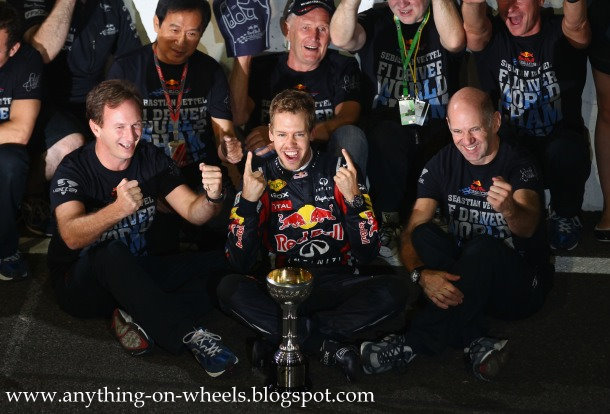 To make such a mighty competitive grid look highly uncompetitive needs some really special skills combined with a car that can complement those skills. And, that is exactly what Sebastian Vettel and the Red Bull RB7 had, the latter courtesy master-designer Adrian Newey. And for most of the races this season, they did make the entire field look highly uncompetitive. Now, digest these facts. With 15 of the 19 races over this season, a Red Bull car has started on pole in every single race with Sebastian Vettel being the wingman in 12 of them. Excepting 6 races in which Jenson won 3, Lewis won 2 and Fernando won 1, Vettel has won the remaining 9 of them. With such figures, its hardly surprising that Vettel has officially sealed his second consecutive world title with 4 races remaining.
 But, it was quite an anti-climax for Vettel in the recently-concluded Japanese Grand Prix at Suzuka, as the RB7 that was untouchable in his hands for most part of the season, was beaten fair and square by the McLaren of Jenson Button and the Ferrari of Fernando Alonso. The latter two along with Lewis Hamilton and Mark Webber, are fighting for the second place in the world championship, which is proving to be more interesting and is where the real action is with four top drivers vying for the spot. It was clearly apparent long back that Vettel was running away with the 2011 championship as he, in that RB7, was a class apart and flying above the rest of the field.
 In a sport where your teammate is considered to be your fiercest rival, Mark Webber has had a tough year as Sebastian Vettel has literally crushed him and, in all probability, his confidence too. To be fair to Webber though, it was his Red Bull that always seemed to have all the problems early on in the season. In doing so, Vettel has become the youngest ever multiple world champion in Formula1’s history, a record held by Fernando Alonso until now. For Sebastian Vettel though, this is just another record in an impressively long list that constitutes youngest ever world champion, points scorer, podium finisher, race winner, race leader, pole sitter and what not.


