Jumat, 04 November 2011

Range Rover Evoque launched in India

It has been just over a year since Land Rover unveiled the Evoque, the smallest model yet to wear the coveted Range Rover badge, to the world. With its stunning looks and proportions that are sure to turn heads wherever you go, there was hardly a doubt that it will succeed and today, just as predicted in my earlier post, the Evoque has met with a tremendous response in all the markets and Land Rover is struggling to produce enough of them. With all the global markets welcoming the Evoque like nothing before, will India be far behind? So, it was not so surprising when Tata Motors announced yesterday during the launch of the Evoque in India that more than 80% of the first batch to be imported has already been booked for.

The Evoque has been positioned as a premium model in India with prices ranging between 44.75 Lacs and 56 Lacs, a tad too expensive for our market. The 5 door model powered by a 2.2 liter SD4 diesel engine, is available in 3 variants - Pure, Prestige and Dynamic, whereas the 3 door 'coupe' model is available only in the top-end Dynamic variant with a 2.0 liter SI4 petrol engine under its hood. Though the Evoque is similar in size to, say a Honda CR-V, befitting its premium positioning, it comes loaded with high-end features such as a pop-out rotary drive selector, an 8-inch touch screen in the central console, a 11 speaker Meridian audio system, paddle shifters in the steering wheel, terrain response, mood lighting and a huge panoramic sunroof.

It's a known fact that Indians love flashy Sports Utility Vehicles that look menacing and huge. Though the Evoque is nowhere close in size to be termed huge, all it has is oodles of oomph and flash that will literally stand out on an Indian road. That, in my opinion, is a perfect recipe for success and I would not rule out the Evoque becoming a common sight in posh hotels and localities across India. In the hindsight, it's good news that both Jaguar and Land Rover are hitting the sweet spot with all their new launches and the factories are struggling to keep up with the demand. They may be high-end British brands, but coming under the ownership of Tata, we Indians have all the more reasons to feel proud of them. Way to go JLR!

Ferrari FF and Lamborghini Aventador launched in India

The same two pieces of automotive machinery that stunned the audience at the 2011 Geneva Motor Show, the Ferrari FF and the Lamborghini Aventador LP700-4, has arrived on the Indian shores sooner than expected. A few of you would remember reading about them here.


Ferrari was the first to launch the FF in India. The Indian public's reaction to the FF would be very interesting to watch out for as this is the company's first-ever hatchback with 4 full sized seats. No, it was not a typo, you read that perfectly right - the FF really is a Ferrari hatchback with 4 seats. Launched on the 31st of October at an ex-showroom price of 3.42 crore rupees, the FF is powered by a 6.2 liter V12 churning out 660 horsepower and 682 Nm of torque. Capable of reaching a top speed of 335 kph, the FF is actually the replacement for Ferrari's grand tourer, the 612 Scaglietti.


With the prancing horse reaching our shores earlier, will the raging bull sit and relax? Never. Lamborghini was quick to react and launched its flagship Aventador LP700-4 in India on the 3rd of November. Launched as a replacement for the Murcielago and following the list of V12 super-cars from Lamborghini like the Diablo, Countach and Miura, the Aventador is a stunner in and out that is sure to leave the onlookers spell-bound. This Italian hypercar is powered by a 6.5 liter V12 engine that churns out 700 horsepower and is capable of hauling the car in excess of 340 kph. Aventador is on sale for an ex-showroom price of 3.69 crore rupees.


Even before launch, Lamborghini has already sold 11 Aventadors in India and Ferrari, not withstanding the craze that the Indians have for the brand, is sure to taste success with the FF. Now, where are the roads to enjoy the true power and speed of these beauties?

Minggu, 30 Oktober 2011

Sebastian Vettel wins inaugural Grand Prix of India

At last, the seemingly never-ending wait that quite a few of our countrymen endured for long, came to an exhilarating end. The inaugral Grand Prix of India, that has long been the stuff of dreams for racing aficionados in our country, just became a reality. As the 24 cars lined up on the Buddh International Circuit at Greater Noida near New Delhi and the five illuminated red lights went off signalling the start of the race, history was created as India stamped its authority on the glamorous world of Formula One. Agreed, there were a few niggles here and there but overall, it was a great show by India as a country on a stage that was visible to millions of people across the world. The event itself, having been attended by over 100,000 people, was a grand success and it is all the more commendable given the humiliation inflicted on our country in the recent Commonwealth Games.


With Lewis Hamilton and Felipe Massa topping the practice sessions on Friday, the gates for qualifying were left wide open on Saturday. Unsurprisingly, it was a Red bull again on pole, just like it was in all but one race this season. And, boy, it was Sebastian Vettel again, putting a blistering lap in the final moments to claim P1. Lewis Hamilton qualified second but was demoted to fifth on the grid for ignoring a double yellow flag during practice. Mark Webber, Fernando Alonso, Jenson Button, Felipe Massa who broke the front suspension during his flying lap and Nico Rosberg came next on the grid. Much to the cheer of thousands of racing fans across India, Adrian Sutil in his Force India qualified eighth ahead of the two Toro Rossos of Jamie Algersuari and Sebastian Buemi. Michael Schumacher could qualify only twelfth fastest. 


Sebastian Vettel, starting from pole, led the race from start to finish and also took the fastest lap, thus capping a perfect weekend for him and Red Bull here in India. Jenson Button took the second place from Mark Webber on the opening lap with a brilliant move and never looked back. Ferrari's perfect timing of the pit stops also saw Alonso leapfrog Webber to the final place on the podium. Mark Webber followed closely in fourth position with Michael Schumacher and Nico Rosberg taking fifth and sixth respectively. Yet again, the seven time world champion drove a solid race for Mercedes starting from twelfth position. Another race, and yet another collision between Massa and Hamilton, the former at fault on this occasion. These two just can't seem to get enough of each other. While Hamilton recovered to finish seventh, Massa hit the kerbs and broke his suspension for the second time in two days, thus ending his race.


Algersuari took some important points for Toro Rosso finishing eighth ahead of Adrian Sutil's Force India and Sergio Perez's Sauber. Narain Karthikeyan, the home hero who started the race in 24th position for the Hispania Racing Team, finished an impressive 17th just ahead of his highly-regarded teammate Daniel Ricciardo. It was only fitting that Sachin Tendulkar, by far India's biggest sporting talent and an iconic cricketer considered as the God of Cricket, waved the checkered flag to mark Vettel's victory. And that also marked the end of a hugely successful inaugural Grand Prix of India with a rumored 110,000 fans watching the event live from the stands. In the end, all we can say is that it was a job extremely well done by the organizers and all others associated with it.


Images Source: www.espnf1.com & respective owners

Sabtu, 29 Oktober 2011

Renault unveils Micra-based Pulse

Will this badge engineering, which the erstwhile General Motors with an array of brands in its portfolio popularized, ever stop spreading its wings? Just when we thought that Skoda's recently-unveiled and soon-to-be-launched Rapid sedan was an exact photocopy of the Volkswagen Vento, we now have Renault beating Skoda to the crown by unveiling its small car Pulse. Top officials from Renault India unveiled the Pulse in New Delhi today in the presence of Red Bull's Mark Webber and Lotus's test driver Karun Chandok, only the second Indian ever to have got into Formula 1. Renault has been having a great time in F1 with Red Bull claiming both the driver's and the constructor's championships in 2010 and also in 2011 with engines supplied by Renault. It is only fitting that they chose to unveil their all-important small car just before the start of the inaugral Grand Prix of India.

Though it was known earlier that the Pulse is going to be based on Nissan's V Platform that also underpinned the Micra, not even in the wildest of dreams did we expect the same car to be launched with only the badges, logos and, of course, the grille changed. That, in short, sums up the Renault Pulse for you. Look at it from any angle, step into it and check out the interiors from any angle, all you see is the Nissan Micra with the Nissan logo replaced by Renault's. Thankfully, the front end has been slightly redesigned with Renault adding its sporty design touches in the bumper and grille. But again, we can't help but notice the similarity of the front grille with Hyundai's fluidic hexagonal grille. With models like Twingo, Modus and Clio in their hands, it is slightly disappointing that Renault chose to bring the Pulse here instead.

Renault will officially launch the Pulse in the Indian market and announce the prices during the 2012 Auto Expo. The Pulse would be manufactured at Renault-Nissan's Joint-Venture plant near Chennai and exports are also on the cards. Since most of the exterior and interior components are shared with the Nissan Micra, costs can be kept in check due to the huge economies of scale. The Pulse is expected to come initially with the reliable, powerful and fuel-efficient 1.5 liter dCi engine that powers the Nissan Micra. It makes sense in India, as the demand for diesel cars are at an all-time high. A petrol engined variant is expected to be launched a little later. It is also expected that Renault will position the Pulse at a price that is slightly higher than the Micra and project itself as a premium brand. Also present at the event was a sportier-looking Pulse tuned by the company's tuning arm 'Renault Sport'.

With the Nissan Micra already selling only in modest numbers and with the same disadvantages of sparse dealerships and service stations, will the Renault Pulse succeed in India as much as Renault would want it to? Wait a little longer to see for yourselves. 


Image Source: www.zigwheels.com

Rabu, 26 Oktober 2011

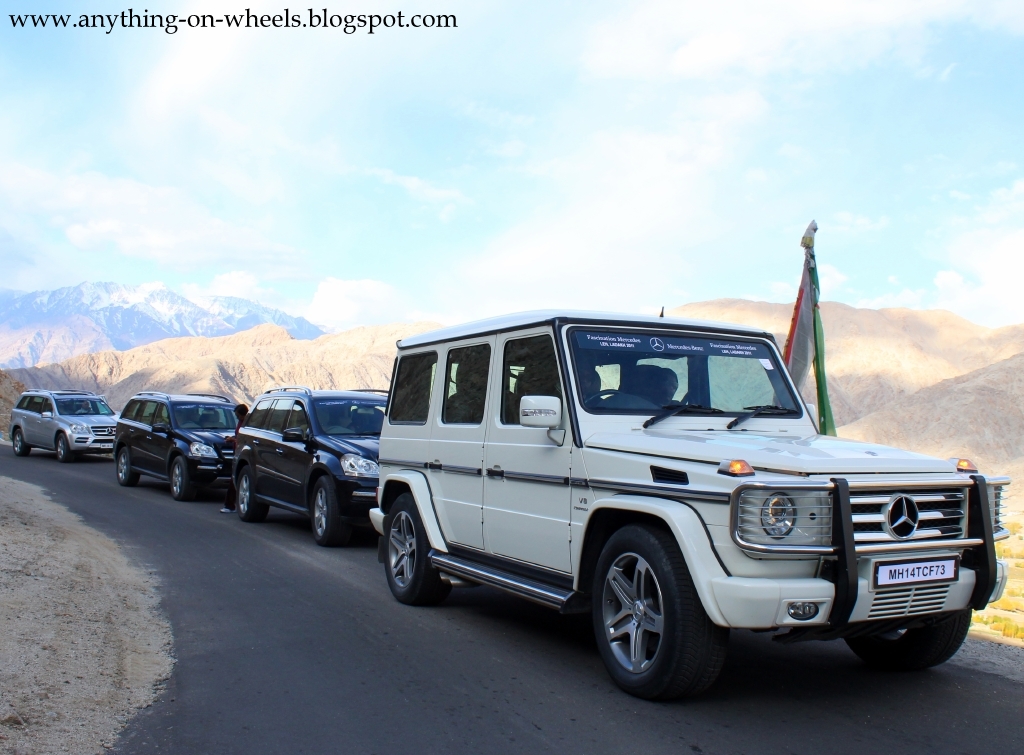
Driven #7: Mercedes-Benz GL-Class & G55 AMG


The heart and mind of an average Indian is a tough nut to crack. What else could explain the fetish that we Indians have for Sports Utility Vehicles (SUV) and the aversion that we show for taking them off-road? It might sound weird but, unlike our pals in Middle East or USA, we Indians hardly take our SUVs off-road and limit their usage to highways and expressways. But, that doesn't stop manufacturers from launching highly competent off-roaders in our country. What better place in India than Leh, with its beautiful mountains and challenging roads, to prove the off-roading prowess of these models? Mercedes-Benz knows this only too well and so, they had organized an “Offroad Driving Experience” there of the two new Sports Utility Vehicles in their lineup, the G55 AMG and the GL-Class.


When Mercedes-Benz launched the G55 AMG, the most expensive and the least practical variant of the G-Class in India, they just wanted to prove a point. With classic looks that could rival a Porsche 911 for its timelessness, power and acceleration figures that would not look out of place in a Ferrari and off-roading capabilities that could match, if not beat, that of a Jeep, the G55 AMG is what most enthusiast’s dream car would be made up of. With such a pedigree behind it, bring the GL-Class into the picture and together, they make a deadly off-roading duo. So, how did these two models fare on the tough terrain that the mighty Himalayas had on offer? Read on, to know.


TO LOOK & FEEL:


There are very few cars on earth that look, feel and drive the same way as they did decades back. Mercedes-Benz G-Class, the name of which is derived from Geländewagen (German for ‘overland vehicle’), belongs to that rarefied category. It is square, it is boxy, it is old, yet it is mind-blowingly attractive. It has been around and has looked almost the same since its introduction in the year 1979, yet its mass appeal is timeless. It was, and still is, so popular that Mercedes-Benz was forced to continue production of the G-Class even as it intended to stop the model around a decade back. The G-Class was originally designed to be used in the military services and there are lots of countries which still swear by it. Kitted out in the top-end AMG trim, the G55 with the special 'AMG' touches like the star-shaped alloys and the brilliant twin exhausts that are placed on both sides just before the rear wheels make sure that the G55 AMG turns heads wherever you go.


As much as I tried, I was just not able to take my eyes off the G55 AMG and concentrate on the GL-Class that accompanied me for the ride. Do not mistake me, the GL-Class is no slouch either when it comes to looks, with its humongous size and the subtle yet classy chrome bits seeking the attraction of the onlookers. The GL-Class fits in as a large SUV in Mercedes’ lineup with full-sized third row seats, a rarity in India. The GL-Class is so big that the G55 AMG looks so small when parked next to it. Get over its size and you can see some interesting bits like the dual projector headlamps, the attractive Daytime Running Lamps, a big, chunky D-Pillar and the chrome inserts in the rear bumper and number plate garnish. Both the models have a few common ‘typical-Mercedes’ design elements like the horizontal chrome-slatted grille with the huge ‘three pointed star’ logo in the middle, the side indicators in the rear view mirrors and the subtle chrome inserts here and there that adds to the classy looks but, thankfully, does not look overboard.


The interiors in both the models are typically Mercedes with a bland design but a terrific build quality. The GL-Class especially impresses with its layout and the way things are put together. From the driver's seat, the instrument console with the circular scooped-out speedometer and tachometer looks and feels sporty. The theme extends to the center console as well with the air-conditioning vents and other buttons and knobs shaped in concentric circles. One thing that the GL offers you in abundance is 'space'. All three rows can comfortably take in adults unlike most of the other seven-seat SUVs in India. The beige leather seats, the dark wood veneer in the dashboard, the two-tone interiors and the chrome add-ons here and there lend the interiors a classy look and feel.


The G55 AMG in contrast shows its age in the interiors. Everything is square and boxy with the steering wheel, the drilled aluminum pedals, the shiny black inserts in the steering wheel and dashboard and the chrome-ringed dials and buttons doing their best to liven up the interiors. The light cream colored leather seats are another eye-catching element in the G. A casual glance at the interiors of the G is enough to make out that it is designed for some serious off-roading with the chunky grab-handle for the front passenger and the three buttons for locking differentials at the top of the center console. Unlike the GL-Class, the G is not as spacious and wide and it shows with limited space for the occupants.


ON & OFF THE ROAD:


The G55 AMG turns you on the moment you turn its ignition on. The growl from the V8 engine is addictive and is sheer music to an enthusiast's ears. It breaks all the pre-conceived notions that you will be having about a boxy SUV. With 507 bhp from its super-charged 5450 cc engine, it is extremely powerful and insanely quick. The handling is also crisp and inspires confidence but the real deal-breaker is the harsh ride, which is, to put it lightly, uncomfortable for the Indian road conditions. It can chew up miles on smooth expressways all day long and can take the occasional off-roading exercises. Be it rocky mountains, muddy patches or slippery snow, the G55 AMG managed to find its way out aided by its short wheelbase and small front and rear overhangs. The weight distribution is an impressive 50:50 in the front and back and, along with the three locking differentials, the G55 AMG is more than capable off-road than any of its owners in India will ever take it to.


Drive the GL-Class immediately afterwards and there is a world of difference not only with the quality of interiors and space, but also with its 'magic carpet' ride, that most models of Mercedes are famous for. There are two driving modes to choose from - the Sport mode and the Comfort mode with the latter tuned for better ride and the former for sporty handling. In Comfort mode, the GL absorbs most bumps and comes across as a supremely comfortable cruiser. Surprisingly for its size, the GL-Class is as capable as the G55 AMG off-road with its dedicated 'Off-Road pro package' that improves its climb angle, wading depth and ground clearance. The ground clearance can be adjusted to three levels at the touch of a button. There is also a Downhill Speed Regulator (DSR) that allows us to set a speed and take our feet off the pedals while climbing down a hill. With the car automatically controlling its speed at the set level, the manual inputs are needed only for steering the vehicle in the right path.


SPECIFICATIONS:


GL 350 CDI:

* Engine Type: V6

* No of Cylinders: 6

* Displacement: 2987 cc

* Max Power: 224 bhp @ 3800 rpm

* Max Torque: 510 Nm @ 1600 - 2800 rpm

* Transmission Type: 4 MATIC

* Tyres: 275/55 R19 (Front) / 275/55 R19 (Rear)


G 55 AMG:

* Engine Type: V8

* No of Cylinders: 8

* Displacement: 5439 cc

* Max Power: 507 bhp @ 6100 rpm

* Max Torque: 700 Nm @ 2750 - 4000 rpm

* Transmission Type: 5 Speed AT

* Tyres: 275/55 R19 (Front) / 275/55 R19 (Rear)


TO SUM UP: 


I am sure these wonderful shots that have been captured and posted here in this post would have said more than I could ever describe. At the end of the drive, it was a revelation of sorts with what these high-end SUVs are capable of both on and off the road. It is a pity though that most of the customers who buy these models in India would not be venturing off-road at all. Nevertheless, with around 20 bookings already for the G55 AMG that is priced at a stratospheric 1.25 crores on road and the GL-Class continuing with its considerable success since its launch last year, Mercedes-Benz has all the reasons to smile.

Minggu, 23 Oktober 2011

Hyundai Eon launched in India

11 long years after its launch, 5 years after it became India's largest selling car, 1 year since it became the largest selling nameplate in the world, Maruti-Suzuki's Alto finally has a competitor that it needs to worry about. Unsurprisingly, it is Hyundai Motor India, the same company which successfully ended Maruti-Suzuki's stronghold in India in the B segment 13 years back, which is at it again, this time in the A segment. The all-new Eon, Hyundai's smallest and cheapest car yet globally, made its world premiere in India on Oct-13-2011 amidst soaring expectations.

The Eon was designed and developed at Hyundai's Namyang R&D Center in Korea with a lot of inputs from the Indian R&D center in Hyderabad. The Eon follows the company's famous 'Fluidic Sculpture' design philosophy with swooping headlamps, hexagonal grille, lots of character lines in the profile and upswept rear windows. From the front, the Eon looks so similar to the i10, Verna and other new Hyundai models across the globe. The profile looks a wee bit over-designed with a lot of curves while the car looks terrific from the rear with huge comma shaped taillamps lending a touch of character. Overall, the Eon is beautifully designed and makes the Alto look very old.

The Eon is powered by a 3 cylinder, 0.8 liter iRDE engine that churns out 56 PS of maximum power and 76.5 Nm of maximum torque. Hyundai claims that the ARAI approved fuel efficiency figure for the Eon is 21.1 kmpl. The car is being offered in six colors with six variants priced between 2.69 Lacs INR and 3.71 Lacs INR. The base D-Lite variant is just a bare-bones automobile with not even AC and power steering being offered while the top-end Sportz variant comes loaed with tilt steering, driver airbag, central locking and audio system with USB and iPod connectivity, many of them segment-firsts, apart from the regular features like AC, power steering and front power windows.

While the Hyundai Eon has all the right ingredients to become a big success, the only factor is its price, that is slightly more expensive than the Alto. Though it looks every bit worth the extra money that it asks, the customers in this segment of the market are extremely price sensitive. Will they find the Eon attractive enough to overcome the premium that they need to shell out to own one or will they continue to patronize the Alto owing to its cheaper price and better service network? The answer remains to be seen.

Rabu, 12 Oktober 2011

Tata Xenon based Commercial Pickup spotted testing near Pune

Unlike many other countries, pickup trucks hardly sell in India as private vehicles. That is why the Xenon XT, an impressive lifestyle pickup made by Tata Motors in India and exported to many other countries, is rarely seen on our roads. Pickup trucks here are all about utility and commercial usage for which the Xenon, with its premium features, good-quality interiors and high price, hardly makes sense. The Mahindra Genio, for example, is what most Indians want and view as a pickup – a modern yet basic workhorse that can withstand the abuses hurled at it by the tough conditions prevailing here. While Tata has its 207Di based pickup in that segment, compared to the relatively new Genio, it looks and feels pretty old.

Tata, being Tata, can easily strip the Xenon off its unnecessary features, cut costs left, right and center and come up with a commercial pickup truck based on the Xenon platform that can well and truly take the game to the competitors like Mahindra’s Genio, Bolero Pikup and the like. And that is exactly what Tata Motors seems to be doing, going by these shots that shows a barebones pickup based on the Xenon platform being tested near Pune. There were two trucks being tested, the one shown in the pictures and the other, a slightly more upmarket version with full wheel caps and body-colored bumpers. Who knows, it might well be equipped with air-conditioning and power windows too, like the top-end Genio DC VX version.

The front end is lifted straight from the Xenon and retains its mean and macho looks with those high-mounted headlights and the massive bumper. There are obvious signs of cost-cutting and commercialization like the black bumpers, grille and door handles and a single black rear-view mirror on the driver’s side. If you are a fan of the clean and rounded profile of the Xenon XT with its integrated cabin and loading bay, you will not like this truck as the loading bay, like all its other competitors, is separate and disjointed from the cabin. The wraparound taillights of the original Xenon are replaced with the trademark rectangular lights. There is no blaming Tata though as the customers in this segment does not look for style but only value utility and ruggedness.
 
Being apparently targeted at the commercial segment, it is highly unlikely that Tata Motors will launch this truck with the same 2.2L DiCOR engine that powers the original Xenon XT. But, if it does, this new truck will be a hoot to drive with class-leading power and torque figures. So, the Mahindra Genio is not going to have the party all for itself for too long as this Tata truck seems to be directly heading against it. God bless competition!